Protect Our Winter Sports
Protect Our Winter Sports
Australia’s winter sports future is at risk.
The impacts of climate change hang heavily over the viability of Australia’s Winter Olympics chances and raises urgent questions about how we celebrate winter sports culture and achievement in a changing climate.
Climate change is reshaping snow sports, threatening Australia’s winter sports legacy, and undermining a core national value: sport.
Shrinking snow seasons are threatening our athletes’ training pipeline and the long-term viability of the Winter Olympics themselves.
Rapid emissions reductions through phasing out coal and gas give us the best chance of protecting Australia’s ski industry, mountain communities, and winter sports prowess.
Government climate policy and sports investment are misaligned. Funding sport while approving new coal and gas fields is pouring fuel on the fire while you’re trying to put it out.
New research says: Fewer venues. Shorter windows. Higher risk.
Climate change is already reshaping when, where, and how the Olympic and Paralympic Winter Games can be held. Changes are needed to keep the Games viable and safer for athletes.

By 2080, only 32% of reliable host locations remain under high pollution scenario.
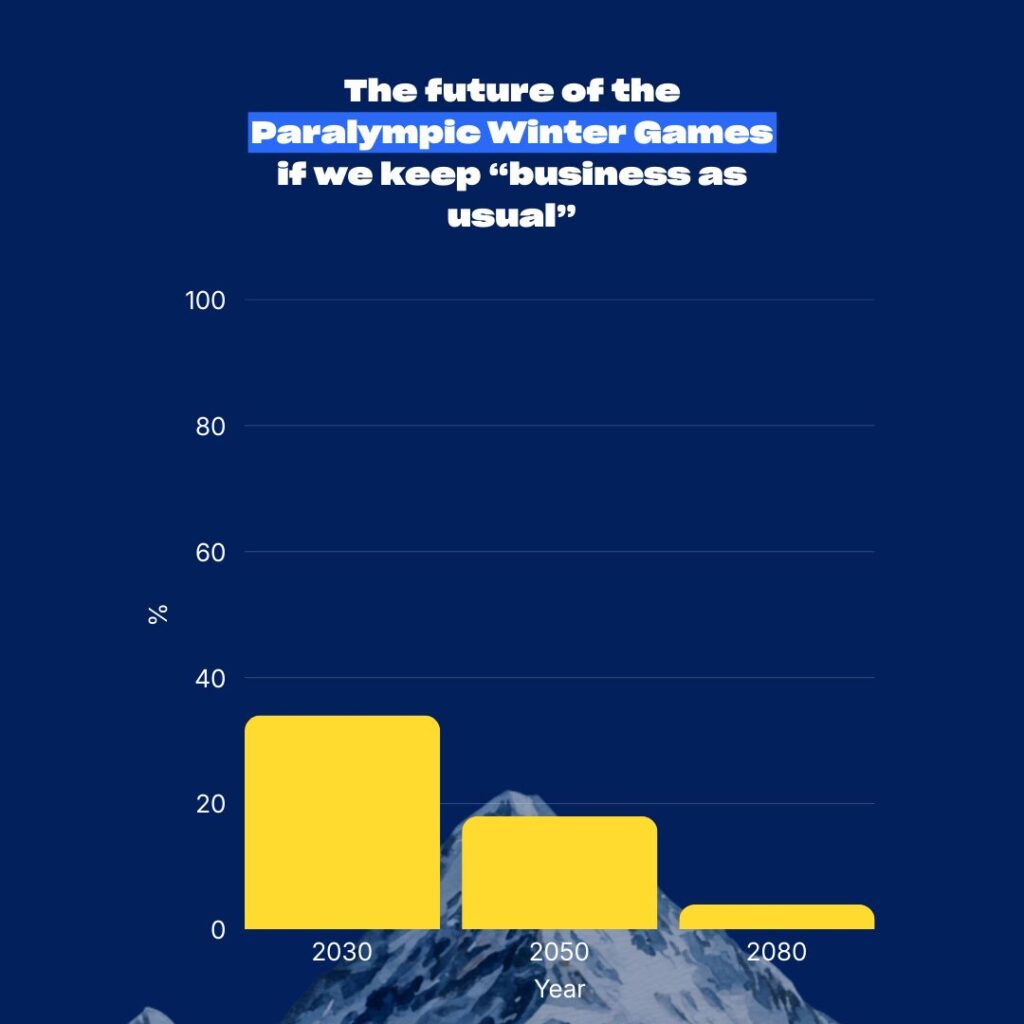
By 2080, only 4% of reliable host locations remain under high pollution scenario.
Research from POW Canada Science Alliance Member Dr. Daniel Scott and team (Dr. Robert Steiger, University of Innsbruck and Dr. Maddy Orr, University of Toronto).
Climate change in the Australian Alps.
- On our current track, a POW x ANU Report projects that ski season length will decline between 44-55 days by 2050 and reliable snow will decrease dramatically.
The global consequences for winter sport are significant.
- In the 2023/24 season, the International Ski and Snowboard Federation (FIS) cancelled 26 of its 616 World Cup races for weather-related reasons.
For the Winter Olympics specifically, the future looks shaky in the absence of action.
- International Ski and Snowboard Federation (FIS) president Johan Eliasch admits that there is no certainty in snow conditions: “We are in the hands of the gods.”
- The Olympic community is well aware of these risks. A 2022 survey found that 90% of Olympic winter sports athletes and coaches across 20 countries had strong concerns about how climate change will affect the future of the sport.
- One of the major sponsors of the 2026 games is ENI, a major Italian fossil fuel company. We do not support sportswashing – our greatest threat should not be sponsoring us.
What can be done?
Our winters depend on rapid climate action, with the most important action being rapidly reducing our use of fossil fuels and prevent expansion of fossil fuels both here in Australia, and abroad. As well as this, adapting to climate change through range of local measures and building a just transition to clear energy sources beyond fossil fuels is crucial.
Take Action
-
Meet the Athletes
calling for climate action to the future of winter sports.
-
Read Our Report
to learn how climate change is shaping the Australian Alps.
-
Sign POW’s Statement
and share your vision for our alpine future.
Protect Our Alpine Future
Protect Our Alpine Future is a grassroots campaign to establish a clear link between the burning of coal and gas and the changes we are seeing in alpine regions. This campaign is a collective call for action to secure a safe alpine future for our mountains and communities through organised, visible pressure for change.
We need the mountains, and the mountains need our help.
It’s time to take back our alpine future.